Bark beetles
The Adventures of Maya the BeeBark beetles appear as modest, industrious inhabitants of the pine bark, but their small size disguises their importance in the forest and their exposure to predators. Fridolin, a father with fifty sons, introduces Maya to a family organized around separate tunnels; his account also shows how many Bark beetles attacking a tree can threaten its life, while a Woodpecker can reach them in the passages they call home.
Identity and Family Life
Near the hole where Maya had settled for the summer, Fridolin and his family lived in a pine tree. He was earnest and industrious, wanted many children, and had taken great pains in bringing up a large family. His fifty energetic sons had each dug a winding little tunnel in the bark. They were settled in their own passages, rather than gathered into a single shared living space.
Fridolin explained that his wife had arranged matters so that no son interfered with another. The brothers were not even acquainted, and each went his own way. The family thus combines a large number of offspring with deliberate separation: its order depends not on the sons’ close association, but on each having a distinct route and place in the tree.
Fridolin’s contact with Maya offered a glimpse of life beyond those tunnels. He visited her in the early morning, as he often did, to greet her and ask whether she had slept well. When she asked about his children, he hesitated and admitted that he no longer supervised them as he once had, though he had reason to believe they were all doing well. His answer suggests the limits of his oversight of a dispersed family, without indicating that anything has happened to the sons.
Work and Ecological Significance
The Bark beetles’ burrowing is both ordinary labor and a potential threat to the tree that houses them. Before sunrise, while the woods were still asleep, Maya could hear Fridolin tapping and boring. She later saw the thin brown dust he had emptied from his corridor. These details make his work legible from outside: the tunnel is not merely a shelter, but the result of sustained activity within the pine bark.
Maya also understood that Fridolin’s people could cause immense harm. If enough Bark beetles attacked a tree, they could destroy its bark and sapwood. The sapwood carries sap upward to the tips of the branches; when it is damaged, the tree loses a vital means of sustaining itself, its green needles wither, and it dies. The narrative notes stories of entire forests falling victim to boring beetles, setting Fridolin’s small figure against the far larger consequences of his kind’s activity in numbers.
This contrast shapes Maya’s response to him. Fridolin’s appearance struck her as almost comical: a little brown figure with shortened-looking wing-sheaths and a breastplate that seemed too large for his body. Yet the knowledge of what his tribe could do made her look at him reflectively and regard him with solemn awe. His importance is not measured by his individual appearance, but by the collective effect of Bark beetles working on the structures trees need to live.
Predators and Vulnerability
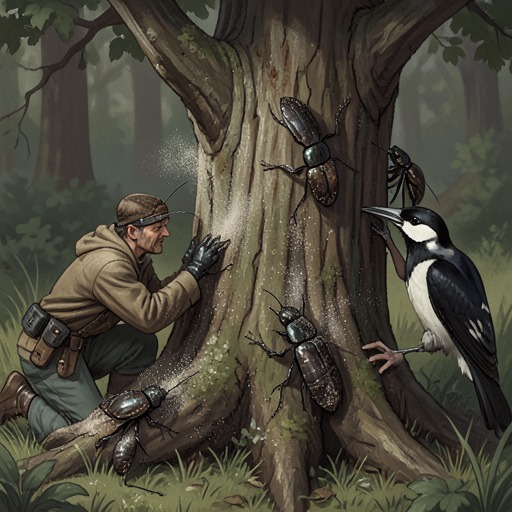
Fridolin identifies Woodpeckers as the danger that shadows his life. He tells Maya that the threat is not simply the bird’s size, but its long, thin tongue, described as wormlike, barbed, and sticky. He says it can extend to many times his own length and probe cracks, crevices, tunnels, and chambers in the bark. Anything caught by it can be drawn out of the Bark beetles’ hidden passages.
The story of Fridolin’s cousin Agatha makes that danger personal. She was visiting him and had not yet become accustomed to his household’s arrangements. While she was there, a small Woodpecker began scratching and boring at the building. Fridolin says that Bark beetles normally hear such activity in time to take shelter, but on this occasion his family heard it too late. Agatha called out that she was stuck; after a brief struggle, there was silence, and the Woodpecker moved on to the neighboring house. Fridolin remembers her by name and recalls the incident in detail, making clear that the threat is not just a general hazard to his kind but a loss within his family.
The episode also reveals the precariousness of the tunnels that otherwise define the family’s way of life. Their separate corridors keep the sons from interfering with one another, but do not protect them from a predator able to probe into the bark. Maya responds with unease, telling Fridolin that his account has unsettled her and recalling that her own adventures have taught her how much can happen to small creatures.
Narrative Role
Fridolin’s encounters with Maya bring together three views of Bark beetles: the family’s internal arrangements, its effect on the tree, and its vulnerability to Woodpeckers. The orderly tunnels and the father’s concern for his children give the insects domestic lives, while the account of damage to sapwood places those lives within the forest’s larger dependencies. Neither view cancels the other: Fridolin can be a courteous visitor and a devoted father, while his people can also threaten trees when they attack in numbers.
Maya’s changing response holds these scales in view. She likes Fridolin and finds no reason to avoid him, yet learns to see the wider consequences of his tribe’s activity. His story of Agatha then shifts the emphasis from the harm Bark beetles may do to the harm they suffer. Through these connected details, the Bark beetles are presented not as a single moral type but as creatures whose work, family arrangements, ecological effects, and dangers are all part of their place in the woods.